Campbell Heating and Air has served Massachusetts and Southern New Hampshire businesses and residences for over ten years. Locally owned and operated, we have a reputation for providing high quality service at reasonable rates, making us one of the leading New England HVAC & Plumbing companies. Call (978) 486-0904.
1. Make certain you set your thermostat to a level you are comfortable with. We recommend setting your thermostat from 68 to 70 degrees. Once you have the thermostat set and you are content with the comfort level we also recommend that you leave it there. It takes less energy to heat air 3-4 degrees than it does to heat air 6-8 degrees. This will also help save on your heating bills. Massachusetts winters are cold so set that thermostat and leave it to save money!
2. We recommend that you clean or replace filters on a furnace once a month.
3. Make sure that any clean warm-air registers, baseboard heaters, and radiators are not being blocked by furniture, carpeting, or drapes. In other words try to maintain your vents ability to flow warm air freely.
4. You should consider placing heat-resistant radiator reflectors between any exterior walls and the radiators.
5. Although fans may help you save money on your air conditioning bill in the spring and summer, we recommend that you use kitchen, bath, and other ventilating fans wisely. These fans can pull out a houseful of warm air in no time. Make certain that you turn them off as soon as they have done their job.
6. Consider keeping draperies or shades open on the south of your home and facing windows during the winter or cold months to allow sunlight to enter your home. You should also close them at night to reduce the cold.
7. Make certain that you purchase energy-efficient equipment if you are replacing any of the appliances or the furnaces in your home. Our technicians are trained on repair, maintenance and installation of all major energy efficient brands and are also an authorized re-seller of most major well known brands.
8. So that you don't waste your hard earned money you should always check these three items to make certain you need a technician:
-Check your thermostat to verify that it is set for "heating".
-Go to your breaker box and make sure that the breaker is on.
-You'll want to check your furnace's switch to make certain that your gas is on.
If you need furnace heating repair, service, or installation and live in the area of Massachusetts of: Westford, Acton, Sudbury, Chelmsford, Concord, Lincoln, Carlisle, Newton, Brookline, Wellesley, Weston, Needham, Dover, Sherborn, Wayland - Call us at (877) 410-3752 or visit us at http://www.campbellheatingandair.com/
Save Energy - Benefits of Buderus Boilers and Heating Systems to Save Energy in your Home. It's easy to save energy with Buderus.
Condensing boiler technology is the most efficient, environmentally friendly form of gas heating available today. Thanks to lower fuel consumption and lower heating costs, condensing boilers usually pay for themselves in only 2 to 5 years. Additionally, a modern condensing heating system increases the value of the building as well as quality of life by reducing emissions. Contemporary condensing technology offers an intelligent, easy-to-install solution to rising fuel costs and meets air quality regulation requirements.
Why Hydronic Heating?
Hydronic Heating Systems and radiant heat from Buderus Efficient Energy Solutions
Buderus commercial boilers are designed to deliver high levels of energy efficiency, reliable heating, and a long product life. Manufactured in Europe to their strict safety standards, all Buderus products undergo rigorous quality tests to ensure total safety, durability, and outstanding performance year after year.
Engineering Made Easy - Thanks to High Quality
Buderus offers advanced condensing technology in a compact, robust form—with high-grade components that meet every demand. All of that plus the freedom to use the available space as you want it, thanks to compact dimensions and the option of a balanced flue operation.
Why Buderus?
Buderus has a full product line including condensing and wall-hung boilers, domestic hot water storage tanks, climate and energy controls, panel radiators, solar heating systems and other hot water heating accessories.
Intelligent Heating for Your Home
Buderus heating systems provide more consistent, more comfortable heat using far less fuel than conventional high-temperature systems.
Why Buderus?
Our Heating Systems Minimize Temperature Cycling
Improved Comfort and Fuel Economy
More Comfortable and Controlled Room and Water Temperatures
EnergyStar Compliant
Whisper-Quiet Wall Hung Boilers
Maximum Efficiency Ratings
Effieciency & Performance
Buderus knows it’s important to keep costs as low as possible yet still maintain high efficiencies, low emissions, and exceptional performance. That’s why we have worked hard to bring all of these qualities together in our full product line.
Energy doesn't come cheap.
According to Maria Vargas, spokesperson for EnergyStar, a division of the Environmental Protection Agency (EPA), energy bills can differ depending on the size and location on your home, but the average household spends $2,200 a year. The good news is these costs can be cut dramatically.
Energy Star, a program started in 1992 to help reduce greenhouse gas emissions and lower energy costs for consumers, offers suggestions for how to reduce your annual electric costs by a third. In other words, you can save about $700 a year on electricity. Last year, Vargas points out, Americans saved about $17 billion on energy bills and reduced green house gas emissions by nearly the equivalent of 30 million cars.
Using data compiled by EnergyStar, MainStreet breaks down your energy bill and identifies the biggest wasters to help you save money (and reduce greenhouse gas emissions!) this winter.
HVAC Systems
<>
"If you really want to cut back on your energy use, you need to focus on heating and cooling your home," Vargas says. That's because these two categories combined account for 46% of your overall electric bill. While most homeowners can't afford a complete overhaul of their homes' heating, ventilating and air-conditioning (HVAC) systems, some changes can increase energy efficiency and include:
• Installing a programmable thermostat, which lets you set temperatures for specific times of day. These devices can save about $180 each year on energy costs.
• Change air filters regularly. The harder your HVAC unit has to work, the more energy it eats away. Filters should really be changed out monthly, especially during the summer and winter months when the HVAC unit has a heavy workload. If you find this tedious, EnergyStar suggests changing filters a minimum of every three months.
• Seal your heating and cooling ducts, especially those running through the attic, crawlspace, unheated basement or garage, as that improves the efficiency of your HVAC unit by as much as 20%.
Water Heater
According to EnergyStar, your water heating system accounts for 14% of your energy bill. Monetarily speaking, the average household spends $400-$600 per year on water heating. To reduce this expense, lower standby losses, such as heat that escapes the water heater and seeps into the surrounding basement area, as well as the amount of hot water you use in your home.
When set too high, or at 140 degrees Fahrenheit, your water heater can waste anywhere from $36 to $61 annually in standby heat losses, and more than $400 thanks to overall consumption. Lower that expense by bringing the heater's thermostat to 120 degrees Fahrenheit or below. Lights Out
In EnergyStar's breakdown, lighting accounts for 12% of bill, but it also represents one of the easiest fixes. In fact, by simply replacing five of your standard incandescent light bulbs with compact fluorescent light bulbs, you can save $70 a year.
Hot Stuff
Appliances only account for 13% of electric bills, so naturally, most people don't upgrade to an energy efficient toaster. Still, if you are committed to reducing the amount of energy you use, you need to focus on larger appliances that use a heat coil, such as a refrigerator or washer and dryer. To do that, make sure that your fridge's filters are cleaned regularly, and consider using only cold water to wash laundry loads. That can save $30 to $40 each year.
But don't be too stingy, Vargas says. Replacing a major appliance, like a refrigerator that is 10 to 15 years old, may help you save in the long term as new technology is constantly subject to federal standards that adjust every year. Energy Vampires
Any appliance or device that sucks up energy when it's plugged in, despite being turned off, is one of these money-draining culprits. According to EnergyStar, this includes most electronic devices, especially those that use some sort of display, like a television, laptop or DVD player.
Slaying energy vampires won't lower your energy bill significantly — electronics only account for about 4% of the total cost — but it's important to keep them in mind, as they consume 75% of the electricity used to power home electronics and appliances. Powering Down
The best way to eliminate this phantom menace is not only to turn energy vampires off, but unplug them. This may be easier said than done, but unplugging a laptop in between uses isn't particularly problematic. However, doing so with your television would require you to wait for the cable to reboot every time you wanted to watch a program.
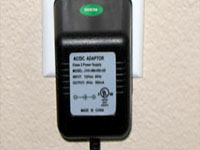
As an alternative, EnergyStar suggests plugging your television and/or DVD player into a power strip and then turning that off when your television is in stand-by mode. Put your computers on sleep mode, or manually turn off the monitor inbetween visits, as opposed to utilizing a screen saver, which, contrary to popular belief, does not reduce energy output. Also, make sure you unplug a battery charger of adapter as it continues to draw energy even when the product no longer needs it. Put Stand By on Stand by
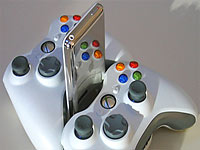
The final 11% of your electric bill comprises devices that don't exactly fit into any particular category. This includes dehumidifiers, external power adapters and video game consoles, which are all considered energy vampires.
An Xbox 360, for example, if left on the draws approximately 1,000 kWh/yr. The PS3 draws 1,300 kWh/yr. According to EnergyStar, these values drop dramatically when users routinely turn the device off after use, lowering annual energy levels down to 110 and 120 kWh/yr, respectively. Since it costs about 12 cents per kWh/yr in the average residential home in the U.S., it costs $120 if to leave your Xbox plugged in for the entire year.
To lower these costs, unplug the devices when you are not playing and only resort to stand-by mode as, well, a stand-by. Energy Star estimates that stand-by power accounts for more than 100 billion kilowatt hours (kWh) of annual U.S. electricity consumption, and $11 billion in annual energy costs.
Produce more hot water using less energy than the most efficient storage tank style heater. Tankless is the environmentally responsible water heating solution. It saves energy, saves space and saves you money.
Endless Hot Water Rinnai tankless water heaters heat the water you need, when you need it. Turning any water source into hot water on demand. You are not limited to the amount a storage tank heater can hold. Whether you are washing the dishes, washing your clothes, or drawing a hot bath, Rinnai's tankless water heater technology will supply endless hot water to your lifestyle demands-even if it demands you do them all at once.
Reduced Energy Costs
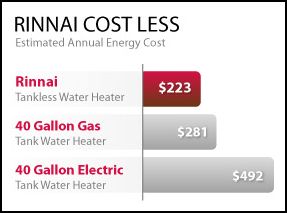
With Rinnai tankless water heaters, you will enjoy up to 40% energy savings. That’s because our units are designed to be highly efficient and only heat water when it is needed. When the demand for hot water ceases, the unit shuts down and uses almost no energy, a revolutionary advantage over inefficient tank-style heaters.
Longevity
Rinnai tankless water heaters have a typical life of up to 20 years, when installed in residential applications. This can be twice as long as a tank style unit.
Clean, Fresh Water
Traditional tank-style water heaters can build up rust and scale inside their tank, where the hot water you use for bathing and drinking is stored. With Rinnai tankless water heaters you will always experience fresh, clean water that is heated on demand, as it passes through the unit.
Space Saving
Traditional tank water heaters can take up to 16 square feet of valuable floor space. However, Rinnai tankless water heaters are about the size of a carry-on suitcase and can be installed on virtually any wall inside or outside of your home.
Greater Capacity
Meeting increased hot water demands can be a challenge for traditional tank-style heaters, however, with Rinnai’s innovative technology you’ll never run out of hot water.
Peace of Mind
With Rinnai tankless water heaters, there’s no tank to leak or break.
The average life expectancy of a furnace is 10 to 15 years. For homeowners who have heating systems that are 10 years or older, now is the time to invest in a high efficiency heating system and reap the savings, in the form of tax credits, before they expire.
The 2009 Federal Stimulus Package stipulated that homeowners could get tax credits of 30 percent (up to $1,500) on the installed cost for purchasing qualifying energy-efficient systems through December 31, 2010. The tax credits apply to high efficiency gas, propane and oil furnaces and boilers.
Homeowners who install a high efficiency heating system and take advantage of the tax credits before they expire will pay up to $1,500 LESS for their system AND see an immediate and significant reduction in their heating bills.
With today’s advanced technologies, homeowners can obtain savings of up to 40 percent on their heating bills with the unsurpassed quality and comfort of an energy efficient furnace.
As much as half of the energy used in your home goes to heating and cooling. So making smart decisions about your home's heating, ventilating, and air conditioning (HVAC) system can have a big effect on your utility bills — and your comfort. Take these steps to increase the efficiency of your heating and cooling system.
Change your air filter regularly
Check your filter every month, especially during heavy use months (winter and summer). If the filter looks dirty after a month, change it. At a minimum, change the filter every 3 months. A dirty filter will slow down air flow and make the system work harder to keep you warm or cool — wasting energy. A clean filter will also prevent dust and dirt from building up in the system — leading to expensive maintenance and/or early system failure.
Tune up your HVAC equipment yearly
Just as a tune-up for your car can improve your gas mileage, a yearly tune-up of your heating and cooling system can improve efficiency and comfort.
Install a programmable thermostat
A programmable thermostat is ideal for people who are away from home during set periods of time throughout the week. Through proper use of pre-programmed settings, a programmable thermostat can save you about $180 every year in energy costs.
Seal your heating and cooling ducts
Ducts that move air to-and-from a forced air furnace, central air conditioner, or heat pump are often big energy wasters. Sealing and insulating ducts can improve the efficiency of your heating and cooling system by as much as 20 percent — and sometimes much more.
Focus first on sealing ducts that run through the attic, crawlspace, unheated basement, or garage. Use duct sealant (mastic) or metal-backed (foil) tape to seal the seams and connections of ducts. After sealing the ducts in those spaces, wrap them in insulation to keep them from getting hot in the summer or cold in the winter. Next, look to seal any other ducts that you can access in the heated or cooled part of the house.
Consider installing ENERGY STAR qualified heating and cooling equipment
If your HVAC equipment is more than 10 years old or not keeping your house comfortable, have it evaluated by a professional HVAC contractor. If it is not performing efficiently or needs upgrading, consider replacing it with a unit that has earned the ENERGY STAR. Depending on where you live, replacing your old heating and cooling equipment with ENERGY STAR qualified equipment can cut your annual energy bill by nearly $200. But before you invest in a new HVAC system, make sure that you have addressed the big air leaks in your house and the duct system. Sometimes, these are the real sources of problems rather than your HVAC equipment.
Ask about Proper Installation of your new equipment
Replacing your old heating and cooling equipment with new, energy-efficient models is a great start. But to make sure that you get the best performance, the new equipment must be properly installed. In fact, improper installation can reduce system efficiency by up to 30 percent — costing you more on your utility bills and possibly shortening the equipment's life.
When filters become clogged with debris, they cut down on a heating system's efficiency and, over time, can cause parts to wear out faster. A permanent air screen or electronic air filter should be cleaned according to the manufacturer's recommendations. Disposable filters should be checked periodically—monthly during winter—and cleaned or changed as needed. Pleated fabric filters are a good, inexpensive choice for reducing dust and allergens.
In addition to regularly inspecting your heating system's filter, brush and vacuum the heat exchanger surfaces every year if recommended by your owner's manual. Before heating season, clean the blower blades and seal any air leaks in ducts with several wraps of duct tape.
Here's how to change or clean a filter:
1) Turn off the power to the unit.
2) Look for the door or panel that conceals the blower; sometimes this is marked "Filter." Lift this door or panel off its holding hooks, or unscrew its retaining screws to remove it.
3) Standard filters are mounted next to or under the blower motor. Slide the filter out along its tracks. Check to see whether it is a disposable filter or intended to be cleaned and replaced—this information should be marked on the filter's edge, along with directions for cleaning, if applicable. If it's a disposable filter, its size will be printed on the frame's edge. Make a note of it.
4) Buy a replacement, and slide it into place, noting that arrows stamped on the side indicate the proper direction of airflow; be sure you face these in the proper direction.
5) While you have the furnace open, vacuum out the area around the blower. If possible, slide out the fan unit, clean each fan blade with a toothbrush, and then vacuum with a brush attachment on a vacuum cleaner.
6) Look for oil ports on the motor, normally located near the motor shaft. If the motor has these, apply two to three drops of non-detergent motor oil into each port (you may have to remove a cover plate to do this). Most contemporary motors don't require lubrication, but motors with oil ports should be lubricated once a year.
7) Look for worn belts between the motor and pulleys.
Ideally, you would want to have an expert inspect your heating system at least once a year.